
While looking into ways to live and work in Malaysia long-term, I came across a visa called the Residence Pass-Talent (RP-T).
The possibility of staying in Malaysia for up to 10 years was appealing, but what interested me most was the freedom to work.
As a foreigner in Malaysia, you generally need a company to sponsor your work visa. Depending on the type of work visa, there are also requirements related to salary and job position. So when looking for a new job, it’s not just about whether you’re qualified for the role. You also have to consider whether the company can hire foreigners and sponsor their visas.
I thought the RP-T could remove many of these restrictions. It would allow the holder to change employers without being tied to a specific company, and a legal spouse could also have the opportunity to work without a separate Employment Pass.
Once I decided to apply, I carefully checked the official eligibility requirements. The main applicant appeared to meet all the requirements, including years of employment in Malaysia, salary, overall work experience, and income tax payments.
So, in late March 2026, we submitted an RP-T application.
But after waiting almost four months, the application was rejected. We weren’t given an exact reason.
In this article, I’ll explain the benefits of the RP-T, who can apply, the documents and costs involved, what happened during our application process, and what I learned after the rejection.
What Is the Residence Pass-Talent (RP-T)?
The Residence Pass-Talent (RP-T) is designed for foreign professionals who are already working in Malaysia and want to live and work in the country long-term. It is managed by TalentCorp and allows successful applicants to live and work in Malaysia for up to 10 years.
It is not permanent residency. The pass is issued and renewed through the relevant procedures, allowing a total validity period of up to 10 years.
The biggest difference between the RP-T and a regular Employment Pass is that the RP-T is not tied to a specific employer.
An Employment Pass is issued based on employment with a particular company, so changing jobs also means dealing with visa requirements. With an RP-T, however, you don’t need to apply for a new Employment Pass every time you change employers.
This makes a big difference when looking for a new job. You don’t have to worry as much about whether a company can sponsor your visa. It also gives you more flexibility to explore opportunities in different roles, salary ranges, and working arrangements without some of the restrictions that come with a regular Employment Pass.
Of course, having an RP-T doesn’t mean having exactly the same employment rights as a Malaysian citizen. It also doesn’t exempt you from professional qualifications or other employment regulations.
Still, the possibility of having much more freedom to choose where and how to work as a foreigner was the main reason we wanted to apply.
Who Usually Applies for the RP-T?
The RP-T is not intended for people who are moving to Malaysia for the first time.
It is designed for foreign professionals who have already worked in Malaysia for a certain period.
For example, eligible applicants may include managers, IT professionals, engineers, and professionals working in finance, logistics, or manufacturing, whether at Malaysian companies or international businesses.
Applications are not limited to specific industries. TalentCorp states that professionals from various industries may apply as long as they meet the minimum eligibility requirements.
The RP-T may be particularly attractive to people who:
- Want to continue living in Malaysia long-term
- Want to stay with their current employer while keeping future job opportunities open
- Want to reduce their dependence on employer sponsorship when changing jobs
- Want to build a long-term life in Malaysia with their family or expand their spouse’s employment opportunities
However, the RP-T is not a long-term residence visa that anyone can apply for. Applicants must meet specific requirements related to work experience, salary, and employment history in Malaysia.
What Are the RP-T Eligibility Requirements?
According to TalentCorp, the main eligibility requirements for new applicants are as follows.
| Category | Requirement |
|---|---|
| Employment in Malaysia | At least 3 consecutive years working in Malaysia under an Employment Pass |
| Current visa | A valid Employment Pass with more than 3 months remaining |
| Monthly basic salary | At least RM15,000, excluding allowances and bonuses |
| Income tax | At least 2 years of income tax payments in Malaysia |
| Total work experience | At least 5 years |
| Education or qualifications | A recognized degree or professional qualification |
The salary requirement refers to basic salary, not total compensation. The annual basic salary declared for tax purposes must also meet the minimum requirement of RM180,000.
When we applied in March 2026, the main applicant had been working in Malaysia for approximately 3 years and 3 months.
The main applicant also had more than 8 years of total professional experience and met the basic salary and income tax requirements. The existing Employment Pass still had around 1 year and 7–8 months remaining.
The company also provided the necessary supporting documents.
For these reasons, I didn’t initially think the application was likely to be rejected.
Someone from the same company had already received RP-T approval. I had heard that this person was approved after working in Malaysia for approximately four years.
But what I later realized was that meeting the official minimum requirements and actually receiving approval are two different things.
TalentCorp also states that meeting all the minimum eligibility requirements does not guarantee approval, as the final decision is made by the approving panel.
Documents Required for an RP-T Application
The application itself is submitted through TalentCorp’s official website.
You don’t need to use an agent. The main applicant can create an account, complete the online application form, and upload the required documents directly.
However, preparing the documents takes much more time than completing the online form.
1. Documents Required for the Main Applicant
Based on TalentCorp’s new application checklist, the main documents include the following.
| Document | Details |
|---|---|
| Passport copy | Full-color copy of every page, from the front cover to the last page |
| CV | Updated CV showing current professional experience |
| Degree certificate | Degree certificate with the required authentication |
| Passport photo | Photo with a light blue background, following the specified requirements |
| Employment contract | Contract meeting the stamp duty requirements of Malaysia’s Inland Revenue Board (LHDN) |
| Job description | Updated job description on the company’s official letterhead |
| Tax documents | Income tax filing and payment records for the past 2 years |
| Payslips | Most recent 3 months |
| No Objection Letter | Letter from the current employer, written in Malay |
| Local contact person’s documents | Copy of the Malaysian contact person’s MyKad |
| Local Sponsor Form | Information about the local sponsor |
| Company testimonial | Testimonial issued on the company’s official letterhead |
| Other documents | Additional recommendation letters, where applicable |
While preparing the application, I realized that quite a few documents required help from the company.
In particular, documents such as the No Objection Letter, job description, and employment-related confirmation letters had to be requested from HR or other company representatives.
The degree certificate was another complicated part.
Because the certificate had been issued by a university overseas, it needed to go through an authentication process. This involved visiting the relevant office and paying additional fees.
The online application was simple, but gathering all the documents beforehand was more difficult than I had expected.
2. Documents Required When Applying With a Spouse
If the main applicant is approved for the RP-T, their legal spouse can apply for an RP-T Dependant Pass.
One of the biggest advantages is that a legal spouse holding an RP-T Dependant Pass can work in Malaysia without needing a separate Employment Pass.
The main documents include:
- Full-color copy of every passport page
- Passport photo with a light blue background
- Marriage certificate in English, with the required apostille and/or embassy authentication
- Birth and family relationship documents, depending on nationality and submission requirements
- No Objection Letter from the current employer, if the spouse is already working in Malaysia
- Any additional documents requested
For our application, we submitted a marriage certificate issued in English with an apostille.
Because the marriage certificate had been issued overseas, the authentication process had to be completed in the country where it was issued. The original document then had to be sent internationally.
An apostille is a form of authentication used to verify the origin of a public document issued in another country. Depending on the issuing country, destination country, and requirements of the relevant authority, additional embassy authentication may also be necessary.
For Korean spouses, it is also worth checking whether a Basic Certificate and Family Relations Certificate are required.
South Korea does not issue a birth certificate in exactly the same format commonly used in many other countries. Instead, a Basic Certificate can be used to provide evidence of birth and personal registration details.
During our RP-T application in 2026, the following two Korean documents were prepared and submitted for the Korean spouse:
- Basic Certificate (기본증명서): A document showing birth information and personal registration details, which may be used as supporting evidence in place of a birth certificate overseas.
- Family Relations Certificate (가족관계증명서): A document showing family relationships, including parents.
Both documents were translated into English and submitted with the necessary embassy authentication.
However, this is based on the documents we submitted during our application. It does not necessarily mean that every Korean spouse must submit exactly the same combination of documents. Applicants should check the official checklist and confirm the requirements with the relevant authorities at the time of application.
Marriage certificates issued overseas may also require English translation or embassy authentication.
3. Documents Required When Applying With Children
Children under the age of 18 may be eligible for an RP-T Dependant Pass.
The main documents include:
- Full-color copy of every passport page
- Passport photo with a light blue background
- Birth certificate
- Copy of the birth certificate authenticated by the relevant embassy
- Adoption or custody documents, if applicable
- Any additional documents requested
Children aged 18 or older may be eligible for a Long-Term Social Visit Pass (LTSVP), depending on their circumstances. Parents and parents-in-law may also qualify for an LTSVP under certain conditions.
The type of pass available depends on the family relationship and the applicant’s age, so it is important to check the requirements for each family member.
The lists above are based on the new application checklist. Additional documents may be requested during the process, so it is best to check the latest official checklist before applying.
I Spent Money Unnecessarily Preparing Korean Documents
As a Korean, I also had to check the translation and authentication requirements for documents issued in South Korea.
It can be confusing to figure out which format is required when submitting Korean documents, such as the Family Relations Certificate or Basic Certificate, to an overseas authority.
At the time, I paid a nationally recognized professional translation company in Korea to translate some of the documents into English.
But I later found out that this level of service wasn’t necessary for some of the documents we had prepared.
It would have been enough to translate them into English myself using the examples provided by the Korean Embassy, and then obtain the required authentication from the Korean Embassy in Malaysia.
Preparing, translating, and authenticating documents issued in Korea took more time and money than I had expected.
After this experience, I realized how important it is to check the exact document requirements before paying a translation company.
Of course, this doesn’t mean that every document can be translated by the applicant. Depending on the type of document, issuing country, and requirements of the receiving authority, a certified translation or additional authentication may still be required.
How Much Does an RP-T Application Cost?
RP-T costs are generally divided into the application fee and the processing fees paid after approval.
According to TalentCorp, the current official fees are:
| Fee | Amount |
|---|---|
| Application fee | RM540 per person |
| Processing fee after approval: Main applicant | RM5,400 |
| Processing fee after approval: Legal spouse | RM5,400 |
| Processing fee after approval: Child under 18 | RM4,860 |
| Immigration pass fees | Charged separately |
| Multiple-entry visa fees | Vary by nationality |
The application and processing fees above include 8% SST.
The application fee is non-refundable, regardless of whether the application is approved or rejected. The processing fees, on the other hand, are paid after approval.
I remember paying around RM500 when we submitted the application. However, since we also submitted documents for accompanying family members, I would need to check the receipt to confirm the exact total amount.
Because the application was rejected, we never reached the stage of paying the processing fees.
The Online Application Was Easy, but the Review Process Was Different
We submitted the application through TalentCorp’s official website in late March 2026.
The online system itself was well designed.
It was easy to enter the required information and upload documents, and we could also check the application status online afterward.
The problem was the processing time.
At the time, I expected the review to take around nine weeks. But nine weeks passed without a decision.
We weren’t asked to submit any additional documents.
However, during the review, we were asked to provide the contact details of an HR representative at the company. This was for employment verification, and we provided the details of a senior HR contact.
Then something unexpected happened.
The person handling the verification entered the HR representative’s email address incorrectly.
As a result, the email didn’t reach the intended recipient, and the review was delayed by approximately two more weeks.
It was frustrating that the process took even longer because of an incorrectly entered email address, even though we had provided the correct contact details.
After that, we went back to waiting.
Because the process was taking so long, I called the RP-T helpdesk several times.
The staff were polite, and it was relatively easy to get through by phone. However, the information they could provide was limited.
When I asked when the decision would be made, they couldn’t give me an exact date. Most of the time, I was told that they would pass the inquiry on to the relevant team or that we needed to wait a little longer.
During one of these inquiries, I was told that the approving panel met once a month to review applications.
However, they wouldn’t tell me the exact meeting date.
This was information I was given during my inquiries, not an officially confirmed schedule that necessarily applies to every application.
Although the website allowed us to check the application status, there was no way to know when the review would actually be completed.
In the end, there was very little we could do except wait.
The Rejection Email Arrived Almost Four Months Later
In July 2026, the email finally arrived.
The subject line was Residence Pass – Talent System Approval Notification.
At first, I thought it meant the application had been approved.
But the message said:
After careful review, the Approving Panel has made a final decision, and your application has been deemed UNSUCCESSFUL.
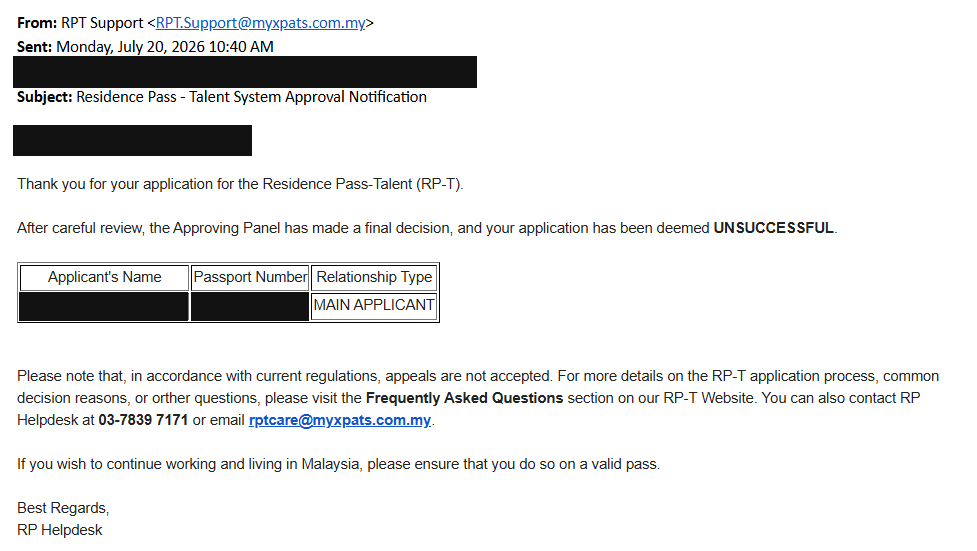
The approving panel had made its final decision to reject the application.
There was no specific reason given.
We didn’t know which requirement was considered insufficient or what had caused the rejection.
We contacted the helpdesk to ask for the reason, but we couldn’t get a clear answer.
After waiting almost four months and spending considerable time and money preparing the documents, the most frustrating part was not knowing what had gone wrong.
The result was especially unexpected because we hadn’t been asked for any additional documents during the review, and the company had already gone through the employment verification process.
Has RP-T Approval Become More Difficult Recently?
Before applying, I had heard about someone who successfully received the RP-T.
Because a person from the same company had been approved, I thought we had a reasonable chance as long as the official eligibility requirements were met.
But after the rejection, I learned about other applications.
There were more rejected cases than I had expected.
Someone in a senior position at the company told me that RP-T approvals seemed to have become more difficult recently. According to what I heard, approvals had been relatively easier to obtain in the past, while rejections seemed to be becoming more common.
Of course, I haven’t seen official statistics confirming a decline in approval rates, so I would treat this as an observation from people familiar with recent applications rather than a verified trend.
I also heard that applicants who had worked in Malaysia for at least four years might have a better chance of approval.
The successful case I knew about involved someone who had worked in Malaysia for approximately four years before being approved.
Hearing this made me wonder whether applying shortly after reaching the three-year mark had been too early.
But there is an important distinction.
The official minimum employment period is still three years. I haven’t found any official rule stating that applicants must have worked for four years to be approved.
So these are observations and opinions based on what I heard from people at the company and the cases around me, not facts that necessarily apply to every applicant.
Can You Reapply After an RP-T Rejection?
According to TalentCorp’s official guidance, appeals are not accepted for rejected new RP-T applications.
There is also a one-year waiting period before reapplying.
In other words, you cannot simply submit another application immediately after being rejected.
At first, we considered trying to find out more about the reason for the rejection or exploring other options.
But since we couldn’t get a clear explanation and appeals were not accepted, we decided not to pursue it further.
Later, the possibility of moving to another country also came up.
The RP-T is particularly valuable for people who plan to stay in Malaysia long-term.
So I felt it might make more sense to reconsider applying in the future, if there was another opportunity to live in Malaysia for a longer period.
What I Would Do Differently If I Applied Again
I still think the RP-T is an attractive option. For foreigners, being able to choose a job without depending on a particular company’s visa sponsorship can make a significant difference.
But if I were to apply again, I wouldn’t rush.
If the main applicant had only just passed the three-year employment requirement, I wouldn’t apply immediately simply because the minimum eligibility criteria had been met.
Of course, working in Malaysia for longer doesn’t guarantee approval. But I would take more time to consider the costs and effort involved, the possibility of a longer-than-expected review, and the one-year restriction on reapplying after rejection.
Most importantly, I wouldn’t assume a positive outcome just because someone I knew had been approved.
What disappointed me most about this experience wasn’t simply the rejection. It was not knowing why the application had been rejected.
If we had known what was missing or insufficient, at least we could have used that information to prepare for another application. But we didn’t even have that opportunity.
Being eligible to apply for the RP-T and actually being approved are two different things.
If you’re considering applying, I hope this experience helps you understand that difference and prepare with realistic expectations.